Proposal hash
1f0c50066851b901c1be511f13f63d99df05c8b28f4fac14f5b5d2773f87ec9fA proposal to the Dash masternode network
DASH Intents
An intent-based execution layer for Dash Evolution. A user signs the outcome they want; market makers compete to deliver it — with masternode operators as the verified tier.
Requested
600 DASH
Structure
6 × 100 DASH
6 monthly cycles
The opportunity
A proven model. A target worth building toward.
NEAR Intents runs the same execution model — a user signs the outcome they want and market makers compete to fill it. In just two years it reached:
$45M+
total fees generated, all-time
830K+
unique users in 30 days
$55M+
in TVL
That is the trajectory this model can produce when it is live and integrated. It is the growth target DASH Intents is built toward — brought to Dash, with masternode operators as its verified market-making tier. It is a comparable, not a forecast of Dash returns: NEAR runs on a mature multi-chain ecosystem at a different scale, and these figures are evidence that the model works, not a projection of what this protocol will earn. Fees accrue only from real volume, and there is no revenue until there is usage.
Total fees generated — cumulative
Illustrative trajectory, not a promise of returns
Source: NEAR Intents, Sep 2026 — @near_intents · Dune Analytics, “Total generated fees All-time.”
The idea
Today, moving value to or from Dash means finding a venue, choosing a route, and accepting the price that route returns. You are picking amethod when what you want is an outcome.
DASH Intents inverts that. A user signs a statement of desired outcome:
“I will pay X of A for at least Y of B, before time T.”
Shielded transactions — natively, as a core feature
Shielded Tokens are a committed core feature of DASH Intents: when they are released, shielded swaps will work natively through the same intent flow — sign the outcome, market makers compete to fill it. This is a stated commitment, not a shipped feature: Shielded Tokens are not yet released, and support lands as soon as they are.
The privacy landscape today: none of the pool-based cross-chain DEXs offers private swaps. Across THORChain (36 pools), Maya (25 pools), and Chainflip, Monero is listed on none of them, and the one privacy coin they do list — Zcash — trades through transparent vault addresses. Monero's decentralized liquidity instead lives on P2P and atomic-swap venues (Haveno, Bisq, eigenwallet, BasicSwap). This commitment is one no pool-based DEX has made.
Both independent and pooled market makers compete to satisfy it. The best offer wins and the trade settles. The user never picks a route, because routing is the market maker's problem — competition on price replaces route selection.
Secured by masternodes
Market making is an open role — anyone may run one. Masternode operators are its verified tier. That is the strategic argument:
No new hardware
You already run infrastructure. A market maker adds no server.
Stake already in place
MNOs already hold Dash and already have economic stake in the network. The collateral itself stays locked and untouched.
Your stake is the credential
The verified tier is masternodes — collateral already at stake, trust by default, while the role itself stays open.
Guardrails against bad actors
Protection comes from three checkpoints, none of which is the relay:
Verified counterparties are masternodes
A verified offer carries a ProTxHash, resolved against the active masternode list from Dash Coreprotx list valid. Unverified offers are permitted but labeled, and a client can filter them out, whichever relay carried them.
Verified payment goes only to a chain-derived address
A verified market maker never supplies a receiving address. The address is read from Dash Core's own record for the verified ProTxHash — no field exists in which a verified counterparty could redirect a payment.
Sanctions screening is committed
The protocol will screen counterparties against the OFAC SDN list before a settlement is broadcast. This is a stated commitment, not a claim: it is not implemented yet, and it is listed as unfinished work below.
A limitation we will not paper over:settlement happens on Dash Layer 1, and Layer 1 has no address screening at consensus. Sanctions screening is therefore aself-imposed policy in our own client and prover, not a property of the network. It can be relied upon because we control the client that broadcasts, and it should be understood as exactly that.
Three ways a masternode earns
This is worth stating precisely, because a simpler version of it would be misleading.
1. As an Independent Market Maker
You earn the spread between the input you accept and the output you deliver — you set the ceiling yourself. The role is open to anyone; masternode operators are its verified tier.
2. By participating in the Titan Pool
The Titan Pool is a shared pool of assets, run on the Evo Titan platform. Participants contribute assets, buy shares, and receive rewards pro-rata. Its exact mechanics are still being finalized.
3. From the Treasury
The Treasury pays 80% of protocol fees to masternode operators.
What a $1,000 trade yields, by tier
Protocol fee is fixed; maker spread is illustrative — the maker sets it.
On top of the spread, a protocol feeis charged in basis points on executed volume and accrues to the treasury the masternode network controls.
| Trade value | Protocol fee |
|---|---|
Up to $1,000 | 15 bps (0.15%) |
$1,000 – $10,000 | 10 bps (0.10%) |
$10,000 – $100,000 | 7 bps (0.07%) |
Above $100,000 | 5 bps (0.05%) |
The tiering is deliberately regressive: small trades pay the highest rate. Small trades cost the same to settle as large ones, and raising minimums to protect margin would exclude exactly the everyday usage that makes the network useful.
Each range is inclusive at its upper bound, so a trade at exactly $1,000 pays 15 bps.
Stated as intent, not yet built: the Treasury's 80% distribution to masternode operators is a design decision this proposal commits to; the disbursement mechanism is part of the funded work and does not exist in the software today. The Titan Pool's exact mechanics are still being finalized.
What already exists
This is not a concept. Substantially all of it is built and deployed on testnet today:
- Dash Platform Data Contract, live on testnet, v1
- SDK for TypeScript and JavaScript
- Masternode daemon evomm in Rust, with a text menu, terminal dashboard, and loopback web UI
- Nostr offer layer
- Website and documentation
- NIP-05 identity published
- Write-path prover available at prover.sansbank.dev
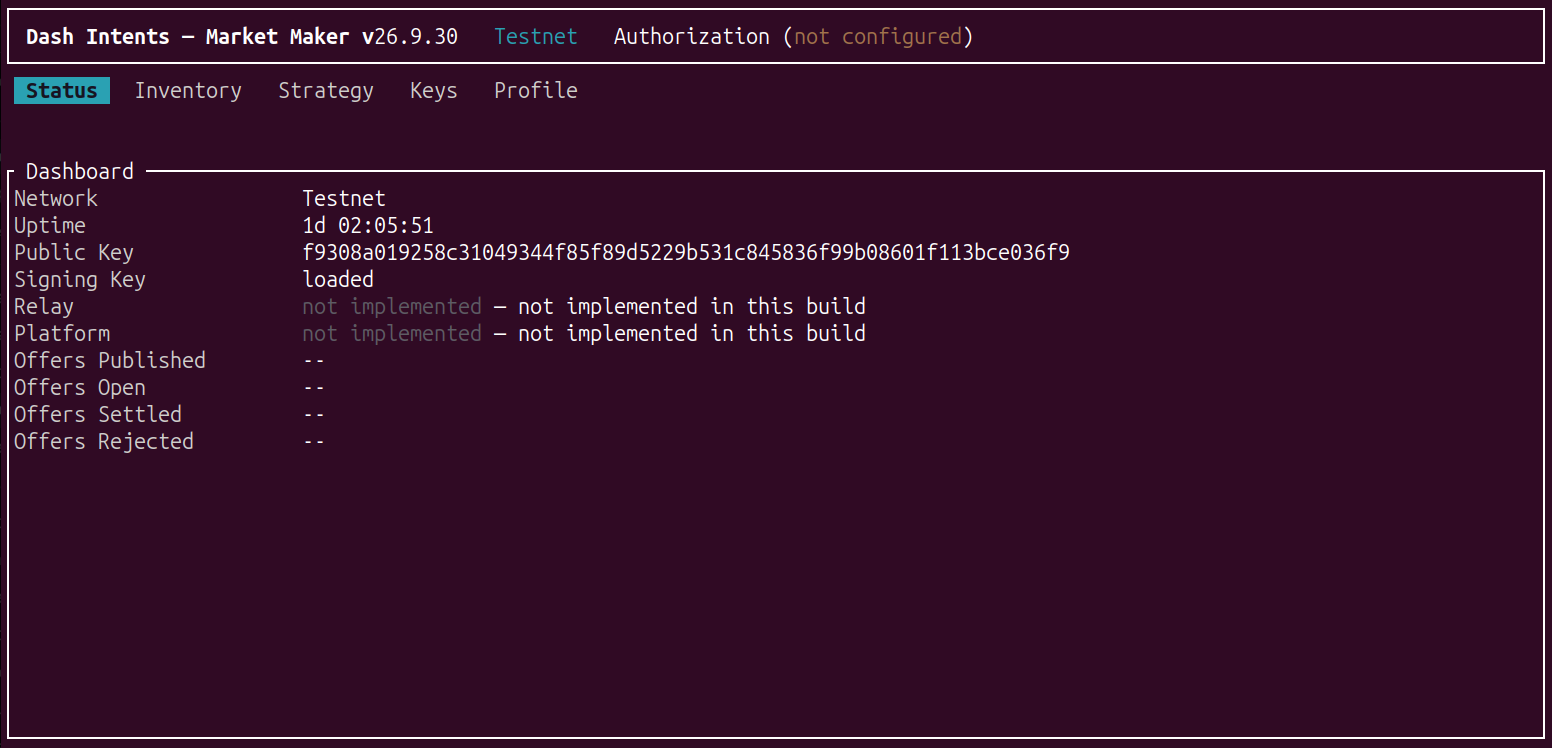
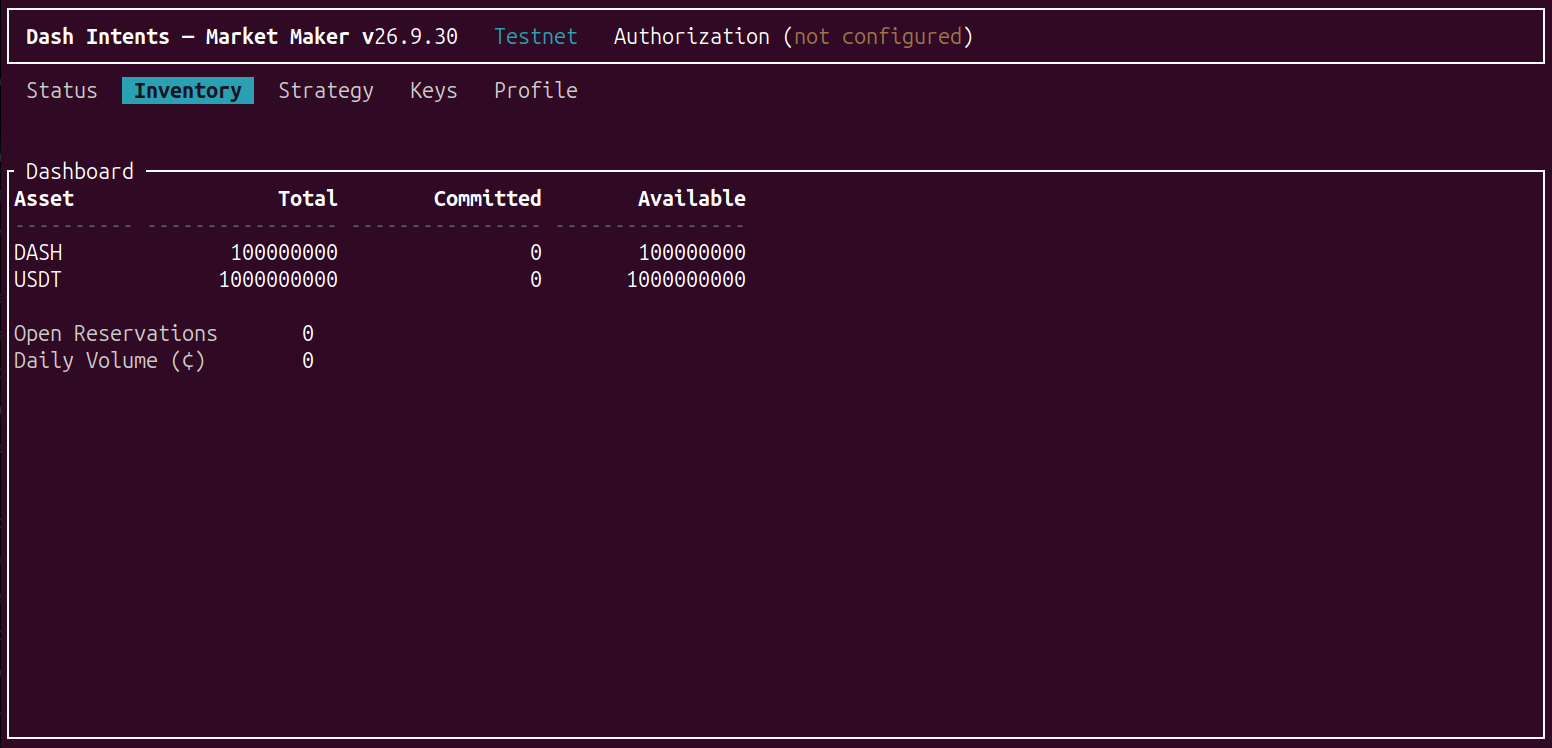
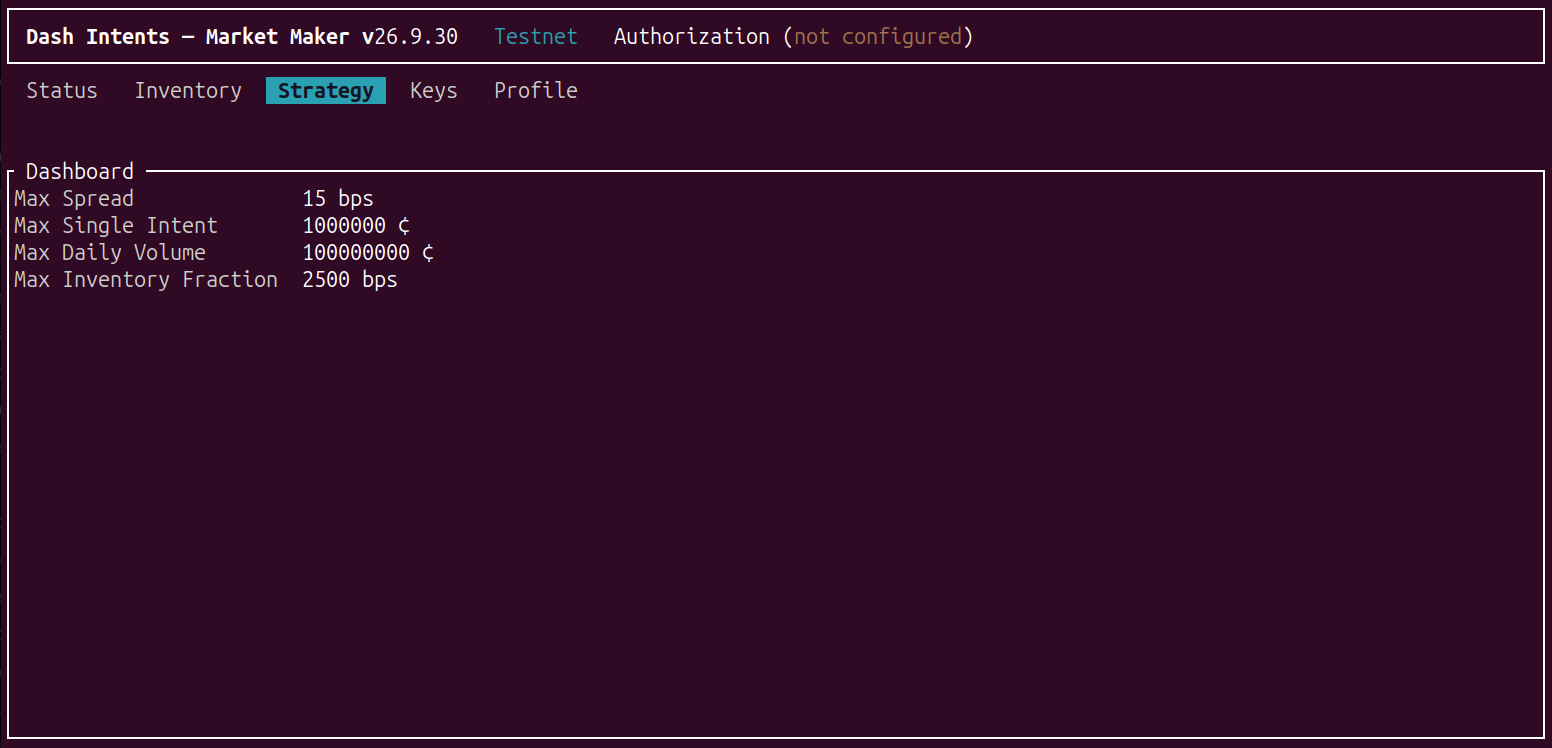
Three views of the market maker daemon, evomm v26.9.30 — the text menu, the terminal dashboard, and the read-only web UI on loopback. As posted to the forum thread; the same daemon serves all three interfaces.
The Data Contract is public and independently inspectable: 66UbfEca1EFPRTm6zMz8HL7Rp1WkGh9wxJ7QhZjYS2ih
Every line above is dated and linked in the changelog — the Cycle 1 deliverable.
The design is deliberate about where data lives. Two documents define the on-chain contract — intent andsettlement. The Dash Platform contract is written exactly twice per intent, once at creation and once after settlement. Offers are never written to Platform at all; they are exchanged only over Nostr, because offer traffic is high-frequency and ephemeral while on-chain writes are rare and permanent.
What is not done — stated plainly
You should hear this from us rather than find it later. If any of these is a deal-breaker for you, that is worth knowing now.
The write path is not complete
Reads work against the live contract. Signature-dependent writes are served by an external prover, and prover.sansbank.dev is now available to carry them; the path is not wired end-to-end yet.
Testnet only
The mainnet Data Contract is not registered. That needs a funded mainnet identity — a discrete and well-understood step.
The write path is served externally
A Cloudflare V8 isolate cannot perform the required signature operations — ECDSA/secp256k1 throws NotSupportedError in that runtime, and Schnorr over secp256k1 is unavailable entirely. Signature-dependent work is delegated to an external prover at prover.sansbank.dev. This is the largest remaining item.
Offer verification is not yet wired
A relay does not enforce who may publish — it is trivially replaced. We are not implementing domain-based or IP-based filtering. Our client software views every offer it can see and labels each by verification tier — verified offers resolve to an active masternode. The verification source is the active masternode list from Dash Core protx list valid; what remains is to wire that check into the client.
Sanctions screening is not yet enforced
The protocol intends to screen counterparties against the OFAC SDN list before a settlement is broadcast. A basic name-screening utility now ships in the SDK — it checks counterparty names against the live SDN list and fails closed — but nothing in the settlement path calls it yet, so enforcement is the unfinished work. Note also that Dash Layer 1 has no address screening at consensus, so this check must be self-imposed in our own client rather than enforced by the network. It can be relied upon because we control the client that broadcasts — and it should be understood as exactly that.
No CI is running
The workflows are committed and registered, but no job has ever executed on this repository — every run records a startup failure and stops in under a second. Nothing is currently built or deployed by a pipeline. Everything above was built and shipped by hand.
No revenue
The protocol has not launched and has processed no volume. We are not providing a revenue forecast — any fee-revenue projection for an unlaunched protocol would be a spreadsheet, not evidence.
What the 600 DASH pays for
6 monthly cycles of 100 DASH. The work spans software engineering, infrastructure, and external resources — it is not one person's time. There is no second line item: no separate infrastructure budget and no contingency.
| Cycle | Deliverable | Amount |
|---|---|---|
| 1Retro | Already published — the Data Contract, the SDK, the daemon, the offer layer, and the sites | 100 DASH |
| 2Upcoming | Client software, "DASH Intents Market Maker" | 100 DASH |
| 3Upcoming | Live on Testnet | 100 DASH |
| 4Upcoming | Live on Mainnet | 100 DASH |
| 5Upcoming | Hardening, monitoring, and handover documentation | 100 DASH |
| 6Upcoming | Developer onboarding; third-party integration support | 100 DASH |
| Total | 600 DASH | |
Cycle 1 is retroactive. Cycles 2–6 are funded after delivery.
Cycle 1 pays for work that is already complete and published — the deliverable is the changelog above, not a promise. The five remaining cycles are funded only after their work lands.
cycle N work published → cycle N payment at the next superblock
Every disbursement is preceded by delivery, never followed by a promise. The DAO never holds funding for work that has not been done.
Why flat rather than front-loaded. The largest risk is not money — it is the relay blocker above, which is outside our control. Six equal cycles mean we are not holding five cycles of unspent funding if it turns out to be unresolvable.
What we want to know from you
We would rather ask than guess. The first question matters most.
- 1
Would you run a market maker?
The protocol is only as good as its market maker set. If the answer is no, that is the most important thing we could learn before asking the network for funding.
- 2
What would make it worth running?
What return, or what minimum volume, would justify the operational effort for you?
- 3
Is the fee structure right?
Specifically the 15 bps floor on trades under $1,000 — fair to you as an operator, or does it discourage the small-trade volume that would make the network useful?
- 4
Is anything in “what is not done” a deal-breaker?
We listed the unfinished work in detail rather than glossing it. If one of those items is disqualifying in your view, we would rather know now.
A protocol that turns your stake into a service
Dash already has a large, economically committed operator set. Intent-based execution turns that set into a market-making workforce at essentially no marginal cost to each operator.
API live — /v1/health returned 200 when this page was built (2026-10-13T21:16Z).
The facts
- Proposal name
- dash-intents
- Owner handle
- sansbank
- Monthly amount
- 100 DASH
- Payments
- 6 (1 retroactive, 5 prospective)
- Total amount
- 600 DASH
- Payment address
- XfTJ8uohiGYkz4HDC12vMhXoNWndJCAEib
The proposal is live on-chain. A masternode operator votes from Dash Core:
gobject vote-many 1f0c50066851b901c1be511f13f63d99df05c8b28f4fac14f5b5d2773f87ec9f funding yes